






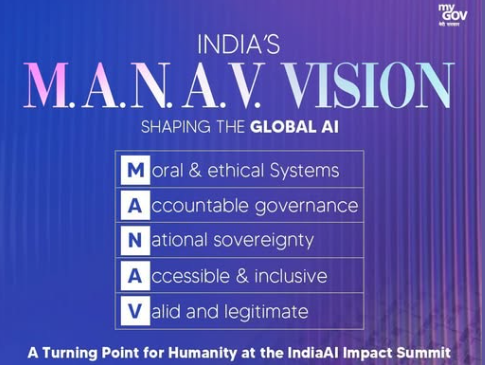
The Prime Minister of India unveiled the M.A.N.A.V. vision at the India AI Impact Summit 2026, highlighting the country’s human-centered approach to governing Artificial Intelligence.
M.A.N.A.V. Vision – India’s Human-Centric AI Framework
What it is:
M.A.N.A.V. (PM Narendra Modi’s Human-Centric AI Odyssey) is India’s guiding framework for the development and governance of Artificial Intelligence, designed to place human values, ethics, inclusivity, and trust at the center of technological advancement.
Aim / Objectives
- Ensure AI development remains ethical, accountable, and inclusive.
- Balance technological innovation with human dignity, safety, and legal safeguards.
Democratize access to AI across sectors such as governance, education, healthcare, and agriculture.
Key Features – Five Pillars of M.A.N.A.V.
- Moral and Ethical Systems
- Promote fairness, transparency, and human oversight in AI systems.
- Integrate AI literacy and ethics into education via National Education Policy 2020.
- Accountable Governance
- Transparent oversight through IndiaAI Mission and AI governance guidelines.
- Encourage explainable, lawful, and responsible AI deployment.
- National Sovereignty
- Emphasize secure data storage, domestic compute capacity, and indigenous AI models.
- Supported by initiatives such as the India Semiconductor Mission and trusted digital infrastructure.
- Accessible and Inclusive AI
- Democratize AI through Digital Public Infrastructure.
- Platforms like IndiaAI Compute Portal, MeghRaj Cloud, IndiaAI Kosh provide affordable access to startups, researchers, and institutions.
- Valid, Safe, and Legitimate Systems
- Ensure AI systems are trustworthy, legal, and verifiable.
- Supported by IT Amendment Rules 2026 regulating synthetic media, deepfakes, and AI-generated content.
India is advancing the M.A.N.A.V. vision for Artificial Intelligence by embedding ethics, responsibility, and public participation at the core of its AI strategy.
National Education Policy (NEP) 2020:
Under the National Education Policy 2020, digital literacy, computational thinking, and foundational AI concepts are introduced early in the education system. This approach aims to nurture ethically aware, data-driven thinkers who can responsibly navigate and shape an AI-powered future.
Public Engagement:
At the India-AI Impact Summit 2026, the country achieved a Guinness World Record with over 250,946 pledges in just 24 hours for an AI responsibility campaign. This milestone turned ethical AI from a policy objective into a nationwide public movement, reinforcing collective accountability in the development and use of AI systems.
Ensuring Accessible and Inclusive AI
- Digital Public Infrastructure (DPI):
India’s Digital Public Infrastructure framework supports the delivery of affordable, scalable AI-driven solutions across vital sectors such as healthcare, agriculture, education, and public administration, ensuring that technological benefits reach diverse communities. - Expanding Access to Computing Power:
Government-backed platforms like the MeghRaj GI Cloud and the IndiaAI Compute Portal reduce barriers for innovators by offering shared access to high-performance computing resources, including GPUs and TPUs. This enables startups, researchers, and academic institutions to experiment and scale AI applications without prohibitive infrastructure costs. - Strengthening Grassroots Innovation:
Programs such as IndiaAI Kosh, the AI Data Labs Network, and the National Supercomputing Mission promote widespread participation in AI development. By expanding access to datasets, computational tools, and research networks, these initiatives ensure AI progress benefits all sections of society rather than remaining concentrated among a few players.
Regulating AI for Trust, Safety, and Legality
- Addressing Deepfakes and Synthetic Media:
With the growing threat of manipulated digital content to public trust and democratic processes, there is a strong emphasis on making AI-generated outputs traceable, transparent, and legally accountable. - IT Amendment Rules, 2026:
The Information Technology (Intermediary Guidelines and Digital Media Ethics Code) Amendment Rules, 2026 provide a formal definition of synthetically created content and impose clear compliance obligations on digital intermediaries, reinforcing accountability and user protection. - Safe and Trusted AI Framework:
As part of the IndiaAI Mission, this pillar promotes fairness audits, bias reduction mechanisms, and privacy-enhancing system design. The objective is to convert ethical AI principles into measurable standards and enforceable governance practices.
Pax Silica Initiative
- The Pax Silica, launched by the United States in December 2025, is a strategic effort to create a secure and resilient semiconductor and critical technology supply chain.
- Its primary goal is to diversify global dependencies and reduce excessive reliance on China in areas such as critical minerals, energy supply chains, semiconductors, advanced manufacturing, AI infrastructure, and logistics networks.
- A central aim of Pax Silica is to foster a stable economic architecture that enables AI-driven growth and technological prosperity among partner countries.
- Key strategies include encouraging joint ventures and coordinated investments in advanced technology sectors, safeguarding sensitive technologies and infrastructure from high-risk actors, and cultivating trusted innovation ecosystems.
- Participating countries include Australia, Greece, Israel, Japan, Qatar, the Republic of Korea, Singapore, the United Arab Emirates, and the United Kingdom.
Relevance for UPSC CSE:
| GS Paper | Relevance |
| GS Paper II – Governance & Policy | Digital governance, ethical regulation, AI policy frameworks, and the role of the state in regulating emerging technologies. |
| GS Paper III – Science & Technology | Artificial Intelligence, semiconductor mission, digital public infrastructure, innovation ecosystem, and technology-led inclusive development. |
| GS Paper IV – Ethics, Integrity & Aptitude | Ethical dimensions of AI, responsible innovation, technology versus morality, and AI for public good. |
Source : PIB