


Why in News?
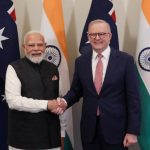
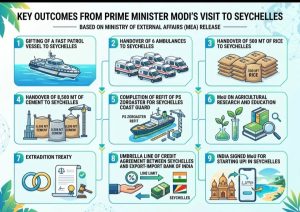
Prime Minister Narendra Modi paid a State Visit to Seychelles, during which both countries signed several agreements to strengthen cooperation in maritime security, defence, digital connectivity, development partnership, healthcare, capacity building, and blue economy.
The visit also marked 50 years of diplomatic relations between India and Seychelles.
Key Highlights of the Visit
- Launch of Unified Payments Interface (UPI) in Seychelles.
- Announcement of a Line of Credit for developmental projects.
- Agreements in maritime security, defence, digital cooperation, health, agriculture, education, and capacity building.
- Reaffirmation of cooperation under India’s Vision MAHASAGAR (Mutual and Holistic Advancement for Security and Growth Across Regions).
- Expansion of cooperation in the Blue Economy and climate resilience.
Strategic Significance
Seychelles occupies a crucial position in the western Indian Ocean, close to major global shipping routes. Strengthened ties are seen as part of India’s broader maritime strategy in the region.
The visit reinforces India’s approach under initiatives such as:
- Security and Growth for All in the Region (SAGAR)
- Vision MAHASAGAR
- Indo-Pacific Oceans Initiative (IPOI)
These frameworks aim to promote stability, cooperation, and inclusive growth across the Indian Ocean Region.
Why is Seychelles Important for India?
1. Strategic Location in the Indian Ocean
Seychelles is located in the western Indian Ocean near critical Sea Lines of Communication (SLOCs) through which a significant share of global trade and energy supplies pass.
Its location makes it strategically important for:
- Maritime surveillance
- Anti-piracy operations
- Protection of shipping routes
- Humanitarian Assistance and Disaster Relief (HADR)
2. Maritime Security Cooperation
Maritime security remains the cornerstone of bilateral relations.
India has supported Seychelles through:
- Coastal Surveillance Radar System
- Patrol vessels
- Dornier aircraft
- Defence training
- Joint Exclusive Economic Zone (EEZ) surveillance
- Hydrographic surveys
The partnership strengthens maritime domain awareness in the Indian Ocean.
3. Countering Emerging Geopolitical Challenges
The Indian Ocean has witnessed increasing strategic competition among major powers.
Closer ties with Seychelles help India:
- Maintain a rules-based maritime order.
- Enhance regional security cooperation.
- Promote a free, open and inclusive Indo-Pacific.
- Balance growing external influence in the Indian Ocean Region.
4. Blue Economy Cooperation
The Blue Economy is an important pillar of bilateral engagement.
Areas include:
- Sustainable fisheries
- Marine conservation
- Ocean-based renewable energy
- Coastal tourism
- Marine scientific research
This aligns with India’s emphasis on sustainable maritime development.
5. Development Partnership
India has emerged as one of Seychelles’ major development partners through:
- Lines of Credit
- High Impact Community Development Projects (HICDPs)
- Capacity building programmes
- Scholarships under ITEC
- Digital public infrastructure
- Healthcare cooperation
These initiatives strengthen people-centric development.
Importance for India’s Foreign Policy
The visit reflects India’s broader maritime strategy based on:
- Neighbourhood First Policy
- Vision MAHASAGAR
- Security and Growth for All in the Region (SAGAR) as its foundational approach
- Act East Policy
- Indo-Pacific Oceans Initiative (IPOI)
It demonstrates India’s emphasis on partnerships with Small Island Developing States (SIDS).
Outlook
The visit is expected to further consolidate India–Seychelles relations into a more technology-driven and development-oriented partnership. With growing cooperation in maritime security, digital infrastructure, and sustainable development, both countries are likely to expand engagement in emerging areas such as the blue economy and climate resilience.
Challenges
Despite strong relations, some challenges remain:
- Increasing geopolitical competition in the Indian Ocean.
- Climate change and rising sea levels affecting island nations.
- Limited financial and institutional capacity of small island states.
- Need for faster implementation of infrastructure projects.
- Ensuring sustainable use of marine resources.
Way Forward
- Expand cooperation in the Blue Economy.
- Strengthen maritime domain awareness through technology.
- Enhance defence and coast guard cooperation.
- Promote digital public infrastructure, including UPI and e-governance.
- Increase collaboration in renewable energy and climate adaptation.
- Deepen people-to-people exchanges through education, tourism, and skill development.
UPSC Prelims Facts (Venezuala)
- Capital: Victoria
- Currency: Seychellois Rupee
- Location: Western Indian Ocean
- Groupings: African Union, Commonwealth, Indian Ocean Rim Association (IORA), Small Island Developing States (SIDS)
UPSC Mains Relevance
GS-II
Topic: India and its neighbourhood; Bilateral, regional and global groupings.
Possible Question:
“Small Island Developing States have emerged as important partners in India’s maritime diplomacy.” Discuss in the context of India–Seychelles relations.