



Why in News?
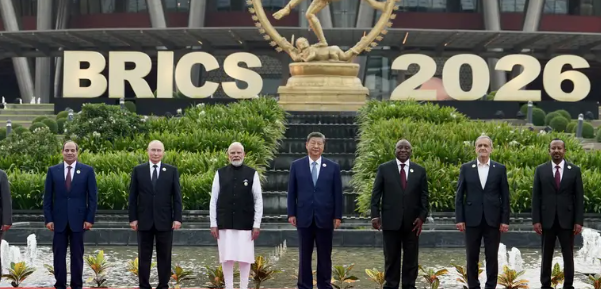
The 18th BRICS Summit was held in New Delhi from 12–13 September 2026 under India’s chairship, with the theme “Building for Resilience, Innovation, Cooperation and Sustainability.” The summit culminated in the adoption of the New Delhi Declaration 2026, comprising 140 paragraphs covering global governance, international peace and security, trade, finance, technology, climate change, health and development.
What is it?
The 18th BRICS Summit marked the institutional consolidation of the expanded grouping, strengthening cooperation across its three core pillars:
-
Political and Security Cooperation
-
Economic and Financial Cooperation
-
Cultural and People-to-People Exchanges
Under India’s 2026 BRICS presidency, more than 400 ministerial, official, and technical meetings were conducted across 30 Indian cities. The presidency sought to advance Prime Minister Narendra Modi’s vision of a people-centric, balanced, and development-oriented Global South agenda.
The declaration comes in the year marking 20 years of BRICS, and follows the expansion of the grouping to 11 members: Brazil, Russia, India, China, South Africa, Egypt, Ethiopia, Iran, the United Arab Emirates, Indonesia and Saudi Arabia. The declaration also stresses greater engagement with BRICS partner countries and the wider Global South.
Major Highlights of the Declaration:
1. Reform of global governance
- BRICS leaders reiterated the need to reform the existing global governance architecture so that it becomes more representative, equitable, effective and responsive to contemporary geopolitical and economic realities.
- The declaration supports comprehensive reform of the United Nations, including the UN Security Council, with greater representation for developing countries from Africa, Asia and Latin America and the Caribbean.
UPSC relevance:
This directly connects with India’s long-standing position on UNSC reform and permanent membership, as well as the broader debate on reforming post-World War II institutions.
2. Greater voice for the Global South
- The declaration places strong emphasis on Emerging Markets and Developing Countries (EMDCs) and Least Developed Countries (LDCs).
- BRICS called for greater participation of developing countries in international decision-making structures and highlighted the Global South’s role in addressing challenges such as climate change, technological transformation, protectionism and geopolitical tensions.
3. International peace and security
- The declaration stresses dialogue, consultation and diplomacy as mechanisms for resolving international disputes.
- It also addresses ongoing conflicts and expresses concern over developments in the Middle East. The BRICS countries called for restraint and diplomatic approaches to conflict resolution.
- The declaration also reiterates opposition to unilateral coercive measures and sanctions that are contrary to international law and the UN Charter.
4. Trade and WTO reforms
- BRICS leaders expressed concern over unilateral tariff and non-tariff measures, arguing that such measures can distort international trade.
- The declaration calls for strengthening the World Trade Organization (WTO) and making the multilateral trading system more responsive to the interests of emerging and developing economies.
- This is particularly relevant for the UPSC syllabus under International Relations, WTO, globalisation and India’s trade policy.
5. Local-currency trade and payment systems
- The declaration supports greater use of local currencies in trade and cooperation on cross-border payment systems.
- It also discusses financial and technological cooperation aimed at making international transactions more efficient and resilient.
UPSC angle: This is relevant to discussions on de-dollarisation, international financial architecture, CBDCs and India’s efforts to internationalise the rupee.
6. Energy transition
- The declaration calls for a “just, orderly, equitable and inclusive” energy transition.
- At the same time, it recognises that fossil fuels will continue to have a role, particularly for emerging markets and developing economies. It emphasises technological neutrality, energy security, diversified supply chains and cooperation on critical minerals.
- This reflects the principle of Common but Differentiated Responsibilities and Respective Capabilities (CBDR-RC) in climate negotiations.
7. Science, technology and innovation
- BRICS reaffirmed science, technology and innovation as important drivers of sustainable economic and social development.
- The declaration welcomes cooperation in areas such as quantum technologies, research and knowledge sharing, and supports the development of a BRICS Science and Research Repository.
- The document also highlights concerns relating to cybersecurity, misinformation, disinformation, deepfakes, data security and the misuse of emerging technologies.
8. Health cooperation
- Health emerged as another important area of cooperation.
- The declaration advances cooperation on mental health, non-communicable diseases, healthy lifestyles and traditional, complementary and integrative medicine. A network of BRICS Centres of Excellence for mental health was also announced, with India’s NIMHANS designated as the coordinating centre.
- The declaration also supports cooperation in pandemic preparedness and health-related early-warning mechanisms.
9. Sustainable and resilient cities
- The summit highlighted cooperation on urbanisation, affordable housing, water and sanitation, sustainable mobility and waste management.
- The BRICS Urban Research and Knowledge Network is intended to facilitate research, knowledge sharing and capacity building for resilient urban development.
-
Expressed grave concern over the humanitarian crisis in Gaza and reaffirmed an unwavering commitment to the establishment of a sovereign and viable State of Palestine within the 1967 borders, with East Jerusalem as its capital, in accordance with the two-state solution, alongside full UN membership for Palestine.
-
Opposed the forced displacement of Palestinians, supported the provisional measures issued by the International Court of Justice (ICJ), and called for unhindered humanitarian access and continued support for UNRWA.
-
Welcomed the ceasefire in Lebanon, called for full implementation of UN Security Council Resolution 1701, and condemned attacks against UNIFIL peacekeepers, expressing deep condolences for the Indonesian and other peacekeepers who lost their lives.
-
Condemned deliberate attacks against peaceful civilian nuclear facilities operating under full International Atomic Energy Agency (IAEA) safeguards.
-
Welcomed African Union-led peace initiatives for Sudan, emphasizing the principle of “African solutions to African problems.”
-
Called for the withdrawal of foreign forces from Syria and urged an end to the unilateral blockade against Cuba, in line with relevant UN General Assembly resolutions.
11. Women’s economic participation
- The declaration recognises the role of the BRICS Women’s Business Alliance in promoting women’s entrepreneurship, leadership, access to finance, technology and markets.
Significance for India:
The New Delhi Declaration is significant for India in several ways:
-
Global governance: It strengthens India’s advocacy for reform of the UN and other multilateral institutions.
-
Global South: It provides a platform for India to articulate the concerns of developing countries.
-
Strategic autonomy: BRICS enables India to engage simultaneously with countries having diverse geopolitical orientations.
-
Economic diplomacy: Greater cooperation in local currencies, payments, trade and investment could reduce vulnerabilities in international transactions.
-
Technology: Cooperation in AI, quantum technologies and digital governance creates opportunities for knowledge sharing.
-
Energy security: Cooperation on energy markets and critical minerals is important for India’s development and energy transition.
-
Health diplomacy: Initiatives involving traditional medicine, mental health and pandemic preparedness align with India’s expanding role in global health cooperation.
Challenges Ahead:
Despite the declaration’s broad agenda, implementation remains important. BRICS brings together countries with different political systems, economic structures and foreign-policy priorities. Reaching consensus on issues such as conflicts, trade, sanctions, technology and international financial reform can therefore be complex.
The expansion of BRICS has also increased the diversity of interests that must be accommodated within the grouping. The practical impact of the declaration will consequently depend on the implementation of its commitments and the ability of members to sustain consensus.
Way Forward:
For India, the key challenge is to translate the broad principles of the New Delhi Declaration into concrete, implementable cooperation.
Priority areas could include:
-
strengthening BRICS financial and payment cooperation;
-
promoting resilient and diversified supply chains;
-
expanding cooperation in AI, quantum technology and cybersecurity;
-
enhancing climate and critical-mineral cooperation;
-
strengthening health and pandemic preparedness;
-
advocating meaningful reform of multilateral institutions; and
-
ensuring that BRICS remains responsive to the priorities of the wider Global South.
UPSC PRELIMS POINTERS
BRICS 2026:
-
18th BRICS Summit: New Delhi
-
Dates: 12–13 September 2026
-
India’s BRICS Chairship theme: Building for Resilience, Innovation, Cooperation and Sustainability
-
Outcome: New Delhi Declaration 2026
-
Declaration: 140 paragraphs
-
Key themes: Global governance, Global South, trade, finance, energy, technology, health and sustainable development
-
Next BRICS Chair: China in 2027
Conclusion:
The 2026 BRICS New Delhi Declaration represents an effort to consolidate the expanded 11-member grouping into a more institutionalized and operational platform for cooperation.
Its agenda combines positions on major geopolitical issues — including UN reform, Palestine, terrorism, and regional conflicts — with practical initiatives in areas such as local-currency settlements, cross-border payments, Digital Public Infrastructure, artificial intelligence, food security, climate action, space cooperation, and public health.
Overall, India’s 2026 presidency emphasized a development-oriented and Global South-focused agenda, seeking to accommodate differences among BRICS members while expanding cooperation across economic partners.
Sources : PIB, The Indian Express