







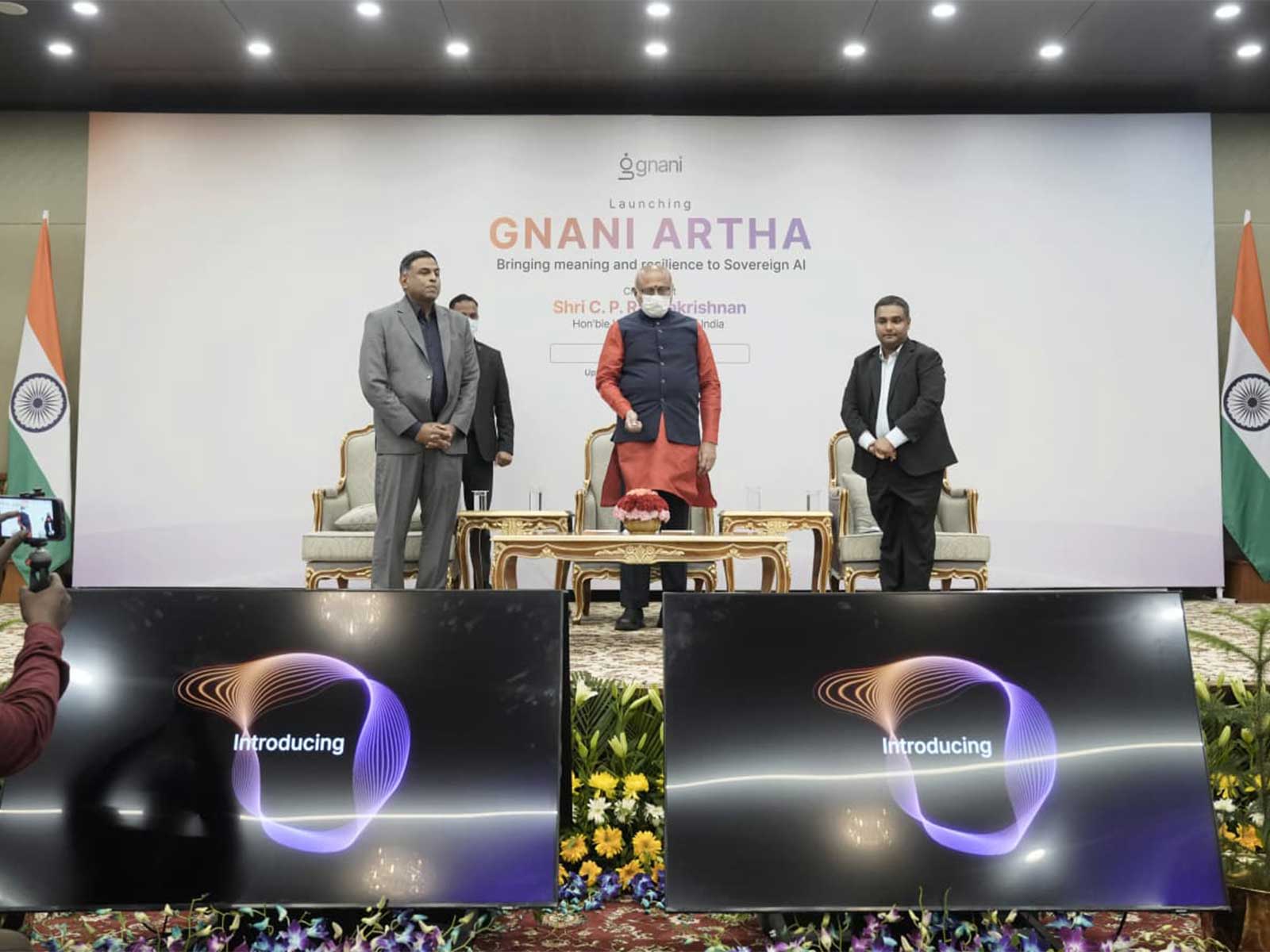
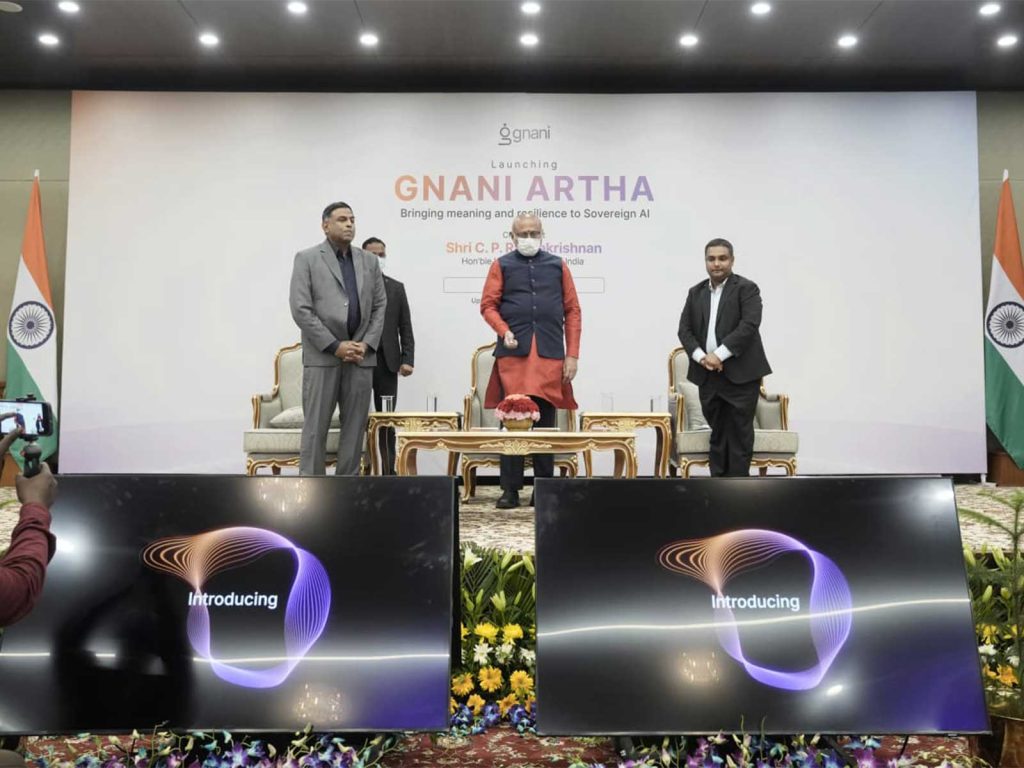
Cpntext : The Vice President of India has launched ‘Gnani Artha’, an indigenously developed sovereign Artificial Intelligence (AI) stack featuring the Evon 3.3 language model and the Plexus agentic AI platform.
What is Gnani Artha?
Gnani Artha is an end-to-end indigenous sovereign Artificial Intelligence (AI) technology stack developed for Indian enterprises and public institutions. The platform brings together two key components: Evon 3.3, a foundation language model, and Plexus, an enterprise-focused agentic AI orchestration platform.
Evon 3.3 is an open-weights, 30-billion-parameter foundation Large Language Model (LLM) fine-tuned using Indic-language datasets and domain-specific tokens. The model is designed to deliver advanced language understanding and reasoning capabilities while addressing the linguistic diversity and requirements of the Indian market.
Plexus is an enterprise-grade agentic AI platform that converts machine intelligence into autonomous, goal-oriented workflows. It enables organisations to integrate AI agents across institutional applications and automate a range of business and operational processes.
Gnani Artha has been developed by GNANI AI, a Bengaluru-based deep-tech startup specialising in conversational and voice-based artificial intelligence.
The Vision Behind Gnani Artha
The platform aims to provide indigenous, secure and cost-efficient AI capabilities while strengthening data sovereignty. It is designed to address the linguistic complexities of Indian languages and reduce enterprise reliance on proprietary foreign AI models and cloud infrastructure.
Key Features
Efficient Mixture-of-Experts Architecture: Evon 3.3 contains 30 billion parameters, but its Mixture-of-Experts (MoE) architecture activates approximately 3.5 billion parameters per token or task. This approach is designed to provide advanced reasoning and language capabilities while significantly reducing computational requirements.
Indic-Optimised Tokenizer: Evon 3.3 incorporates a re-engineered tokenizer optimised for Indian scripts and morphologically rich languages. According to the platform’s specifications, it can require up to 20% fewer tokens per word compared with leading global foundation models, potentially reducing inference costs.
Open-Weights Access: Released under the permissive Apache 2.0 licence, the model’s weights are accessible to researchers and developers, allowing them to inspect, fine-tune and adapt the technology for specific applications.
On-Premise and Single-Node Deployment: The stack is designed to run on single compute nodes within an organisation’s private data centre. This enables institutions to retain greater control over sensitive information while supporting data-localisation and privacy requirements.
Autonomous Enterprise Agents: Through Plexus, non-technical users can create and deploy specialised AI agents using natural-language prompts. The platform can support workflows such as database queries and document verification, with audit logging built into the process.
Why It Matters
Gnani Artha is positioned as an effort to strengthen India’s capabilities in sovereign and indigenous AI. By enabling sensitive data to remain within domestic infrastructure, the technology could help organisations address data-governance and privacy requirements while reducing dependence on overseas cloud and proprietary AI platforms.
The initiative also aligns with the broader objectives of Aatmanirbhar Bharat and Viksit Bharat 2047, supporting the development of locally built generative AI technologies and foundational models tailored to India’s linguistic, institutional and enterprise needs.
A Potential Platform for Indian Enterprises
For businesses, the value proposition of a sovereign AI stack extends beyond national policy.
Enterprises increasingly need to determine where their data is stored, how AI systems process confidential information and how much control they have over models and infrastructure.
A platform built around sovereignty could allow organisations to deploy AI in environments where data governance, security and regulatory requirements are central considerations.
This could be particularly relevant for highly regulated industries, where organisations may be reluctant to send sensitive information to externally controlled AI services.
The Road Ahead
Building a complete sovereign AI ecosystem, however, is a significant technological challenge. It requires investment in computing infrastructure, specialised talent, datasets, cybersecurity, model development and long-term research.
The success of initiatives such as the Gnani Artha Sovereign AI Stack will ultimately depend not only on the technology itself but also on ecosystem adoption, interoperability, cost efficiency and the ability to deliver measurable value to users.
As AI becomes increasingly embedded in economic and public infrastructure, sovereignty is likely to become an important dimension of the technology conversation.
The Gnani Artha vision reflects this broader shift: from simply consuming artificial intelligence to building, controlling and governing the infrastructure that makes AI possible.
If developed at scale, such an approach could contribute to a more self-reliant AI ecosystem—one in which innovation, data, infrastructure and governance work together to create AI capabilities aligned with India’s long-term technological ambitions.
Source : PIB