



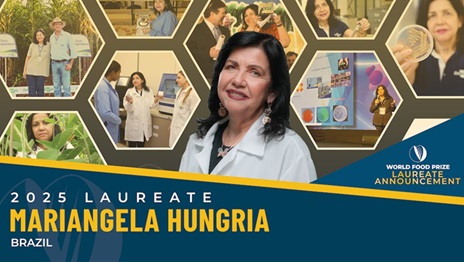
Mariangela Hungria, a Brazilian microbiologist, was awarded the 2025 World Food Prize for her groundbreaking work in biological nitrogen fixation, which has helped reduce dependence on chemical fertilizers.
Her innovations led to Brazil’s “Micro Green Revolution,” greatly enhancing crop yields and reducing input costs.
ABOUT THE MICRO GREEN REVOLUTION
The Micro Green Revolution is an agricultural movement spearheaded by Brazilian microbiologist Mariangela Hungria, centered on the use of biological approaches to boost crop productivity. It emphasizes microbial seed and soil inoculants as sustainable alternatives to chemical inputs.
KEY HIGHLIGHTS
-
Biological Nitrogen Fixation (BNF): Utilizes beneficial microbes such as rhizobia and Azospirillum brasilense to convert atmospheric nitrogen into forms usable by plants, enriching soil fertility naturally.
-
Reduced Reliance on Chemical Fertilizers: This approach has led to significant cost savings—up to $40 billion annually for Brazilian farmers.
-
Improved Crop Yields:
-
Soybean production increased dramatically from 15 million tonnes in 1979 to 173 million tonnes by 2025.
-
Substantial yield improvements were also recorded in common beans and forage crops.
-
-
Land Restoration: Hungria’s team developed the first microbial inoculants for pasture grasses, enhancing biomass production and quality of forage for livestock.
ABOUT THE WORLD FOOD PRIZE
The World Food Prize is the premier international award honoring individuals who have made outstanding contributions to improving the quality, quantity, and accessibility of the global food supply.
Established:
Founded in 1986 by Nobel Peace Prize laureate Norman Borlaug with initial support from the General Foods Corporation.
Administered by:
The World Food Prize Foundation, based at the Hall of Laureates in Des Moines, Iowa, USA.
First Recipient:
M.S. Swaminathan (1987), recognized as the father of India’s Green Revolution.
Award Features:
-
A $500,000 monetary prize
-
A diploma
-
A commemorative sculpture designed by Saul Bass
-
Presented annually in Des Moines during the Borlaug Dialogue International Symposium
-
Honors achievements across fields such as agriculture, nutrition, food policy, technology, soil science, and efforts to combat hunger.
Mariangela Hungria’s work is a powerful reminder that the future of agriculture lies not just in technology, but in our understanding and harnessing of nature itself.
The Micro Green Revolution she leads has redefined sustainable farming in Brazil and holds immense potential for countries around the world seeking to improve yields, cut costs, and protect their ecosystems.
As the global community grapples with food insecurity and environmental degradation, Hungria’s legacy shows that the answers may be microscopic—but their impact can be massive.