







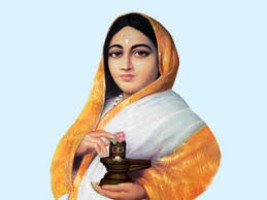
The Prime Minister of India addressed the Mahila Sashaktikaran Mahasammelan held in Bhopal, Madhya Pradesh, to mark the 300th birth anniversary of Lokmata Devi Ahilyabai Holkar.
In the rich tapestry of Indian history, few rulers have left behind a legacy as profound and empowering as Lokmata Ahilyabai Holkar. Born on May 31, 1725, in the village of Chaundi (in present-day Maharashtra), Ahilyabai defied the odds of her time to emerge as one of India’s most respected and visionary rulers. Her 300th birth anniversary, celebrated in 2025, is not just a remembrance but a revival of the values she stood for—justice, compassion, and women’s empowerment.
Early Life
- Born on May 31, 1725, in Chondi village, located in present-day Ahmednagar district, Maharashtra.
- Daughter of Mankoji Rao Shinde, the village head who believed in education and ensured she received one—an uncommon practice for girls at the time.
Despite being born into a humble family, her destiny changed when Malhar Rao Holkar, a commander in the Maratha Empire, spotted her potential and chose her as a bride for his son, Khanderao Holkar.
After the death of her husband in battle and later her father-in-law, Ahilyabai took charge of the Holkar dynasty of Indore in 1767. At a time when few women were even allowed to be seen in public, Ahilyabai not only governed but did so with a combination of strong leadership and deep spiritual conviction.
Rule and Administration
- Reigned over the Malwa region, with her capital at Maheshwar (in modern-day Madhya Pradesh).
- Governed during politically turbulent times with remarkable wisdom, fairness, and inclusivity.
- Personally led military expeditions and founded the Holkar army in 1792.
- Held daily durbars (public audiences) to listen to and resolve her subjects’ concerns.
Public Welfare and Reforms
- Implemented forward-thinking policies aimed at uplifting farmers, artisans, and tribal communities.
- Promoted irrigation systems, crop diversification, and rural entrepreneurship to boost the agrarian economy.
Cultural and Religious Contributions
- Restored and rebuilt hundreds of temples across India, including:
- Kashi Vishwanath Temple in Varanasi (restored in 1780)
- Somnath Temple (Old Juna Mandir)
- Commissioned the construction of ghats, wells, tanks, and dharamshalas throughout the country.
- Built two Jyotirlinga temples and extended support for religious activities across regions.
Social Reforms and Women’s Empowerment
- Championed progressive social measures such as:
- Raising the minimum age of marriage for girls
- Advocating property rights for women
- Supporting widow remarriage
- Formed a women’s army and created village-level safety units to ensure security and autonomy for women.
Nation-Building Initiatives
- Constructed roads and rest houses along key pilgrimage routes including Rameshwaram, Haridwar, Kashi, and Somnath.
- Established gurukuls and schools to promote accessible education and literacy.
Ahilyabai Holkar was a ruler with a difference. She governed not with fear, but with fairness. Her administrative reforms, social justice, and economic initiatives were revolutionary for the 18th century.
Ahilyabai Holkar is often seen as a torchbearer for women-led governance. Her ability to rule effectively, compassionately, and progressively has made her a symbol of women’s empowerment in India. Her birth anniversary in 2025 was marked by several initiatives across Madhya Pradesh, including the launch of the Devi Ahilyabai Nari Shakti Mission, aimed at promoting health, education, safety, and economic independence for women.
Enduring Legacy
- Passed away on August 13, 1795, at the age of 70.
- Founded the Maheshwari saree industry, a textile tradition still thriving today.
- Revered as the ‘Philosopher Queen’, known for her profound spiritual insight and balanced governance.
- Remembered for integrating development with dharma (duty) and for shaping a model of grassroots governance and cultural preservation that still resonates in modern India.
Even two centuries after her death in 1795, Ahilyabai Holkar remains a beloved figure in Indian history. Statues of her grace towns and temples, and her name is spoken with reverence across communities. The city of Maheshwar, which she made her capital, continues to be known for its handloom saris—a craft she supported and promoted.
Ahilyabai Holkar’s life is a shining testament to what leadership truly means. At a time when the world grapples with the challenges of inequality and injustice, her life reminds us that true power lies in service, compassion, and courage. As we honor her 300th birth anniversary, we do not just celebrate a historical figure—we reignite a legacy that continues to guide and inspire.