





Reflecting on India’s Democratic Detour, Five Decades On
By admin| 25 June 2025
“Democracy means nothing if people are not able to express their views freely.” — Indira Gandhi (ironically, before 1975)
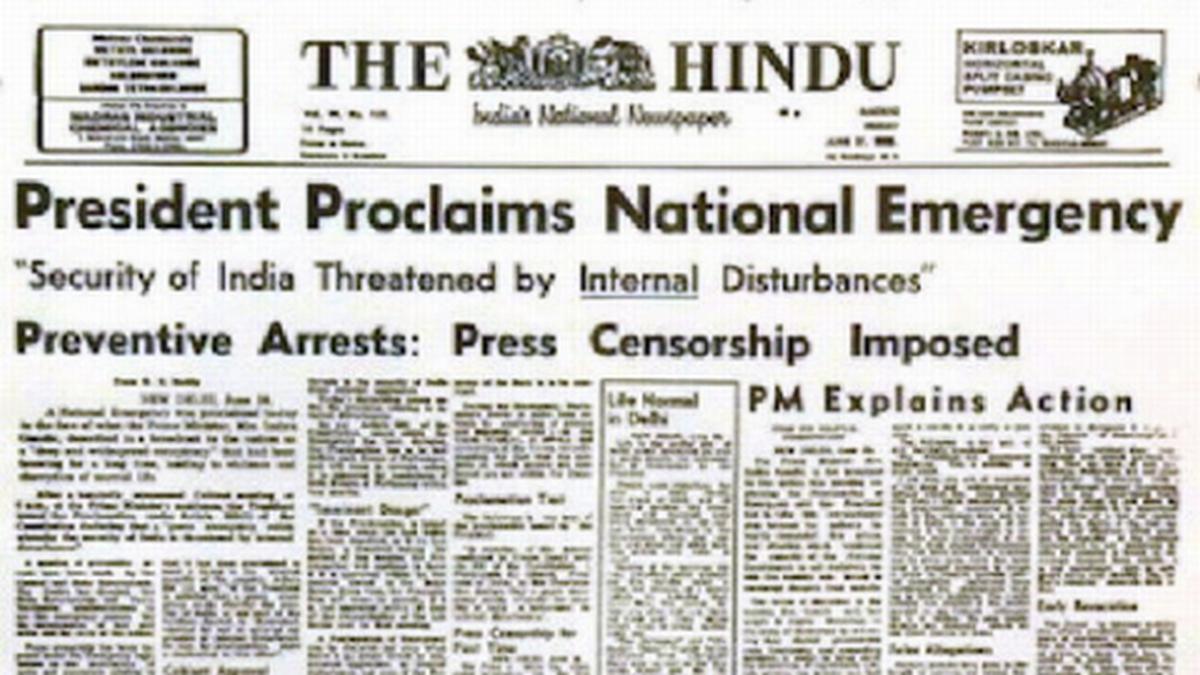
On 25 June 1975, a single radio announcement sent shockwaves across the nation. Prime Minister Indira Gandhi had advised the President to declare a national Emergency, citing internal disturbances. Overnight, India—the world’s largest democracy—entered one of its darkest constitutional chapters.
Today, 50 years later, the Emergency still casts a long shadow over our democratic consciousness. It’s a moment that demands not only remembrance but introspection: about power, rights, institutions, and the enduring fragility of freedom.
THE GENESIS OF A CRISIS:
The events leading up to the Emergency were a confluence of political turmoil and judicial pronouncements. On June 12, 1975, the Allahabad High Court found Prime Minister Indira Gandhi guilty of electoral malpractices, unseating her from Parliament and barring her from contesting elections for six years. This verdict, coupled with widespread public unrest fueled by economic hardship and the “Total Revolution” call by Jayaprakash Narayan, intensified pressure on the government. Despite a conditional stay from the Supreme Court, the political climate remained volatile.
Just before midnight on June 25, 1975, on the advice of Prime Minister Gandhi, President Fakhruddin Ali Ahmed declared a National Emergency under Article 352 of the Constitution, citing “internal disturbance.”
THE UNRAVELING OF DEMOCRACY:
What followed was a chilling suspension of civil liberties and a systematic dismantling of democratic norms:
- Suspension of Fundamental Rights: Articles 358 and 359 were invoked, suspending the protections under Article 19 (freedom of speech, expression, assembly, movement) and allowing the suspension of enforcement of fundamental rights under Articles 14, 21, and 22 (equality before law, right to life and liberty, protection against detention). Citizens were barred from approaching courts for redress.
- Press Censorship: Newspapers were subjected to strict pre-censorship, with power supply to newsrooms often cut. Editors were required to obtain government clearance before publishing any content.
- Mass Arrests and Detentions: Thousands of political opponents, journalists, and activists were arrested and imprisoned without trial under laws like the Maintenance of Internal Security Act (MISA).
- Constitutional Amendments: A series of amendments, most notably the 38th, 39th, and the infamous 42nd Amendment (often called the “Mini Constitution”), were rushed through Parliament. These amendments aimed to insulate executive actions from judicial review, diminish the power of the judiciary, and centralize power in the executive.
- Controversial Policies: The Emergency also saw the implementation of highly controversial policies, such as the forced sterilization campaign spearheaded by Sanjay Gandhi, which resulted in over a crore sterilizations and caused immense suffering.
- India’s Constitution, often hailed as a robust framework for pluralism and rights, was twisted into an instrument of control. The Emergency exposed loopholes that allowed an authoritarian drift.
The Judiciary, too, stumbled. In the infamous ADM Jabalpur v. Shivkant Shukla case (1976), the Supreme Court ruled that even the right to life could be suspended during the Emergency. This betrayal would haunt Indian jurisprudence for decades.
The Emergency ended in March 1977, following an unexpected defeat of Indira Gandhi in a general election. It was the first time the people of India used the ballot as a blunt force tool to punish autocracy.
The new Janata government passed the 44th Constitutional Amendment in 1978, aiming to ensure:
- Stricter conditions to declare future Emergencies
- Restoration of fundamental rights
- Safeguards against arbitrary detention
A chastened nation recommitted to democracy, but the lesson was clear: never again could any leader or party take the Constitution for granted.
At 50, the Emergency is not just history—it’s a mirror. In an era marked by rising authoritarianism globally, suppression of dissent, and attacks on press freedom, the ghosts of 1975 feel eerily familiar.
The Emergency reminds us that:
- Institutions must be fiercely independent
- Freedom of expression is non-negotiable
- Citizens must remain vigilant
- Constitutional morality must rise above political expediency
The right to protest, question, write, speak, and challenge power—these are not privileges. They are hard-won rights that must be defended anew by every generation.
Let us ensure that the lessons of the Emergency are never forgotten, and that India’s vibrant democracy continues to thrive, stronger and more resilient than ever before.
As we mark 50 years since the Emergency, it is our duty—not just as Indians, but as citizens of a global democratic community—to ensure such a moment never repeats itself.