








Why in News?
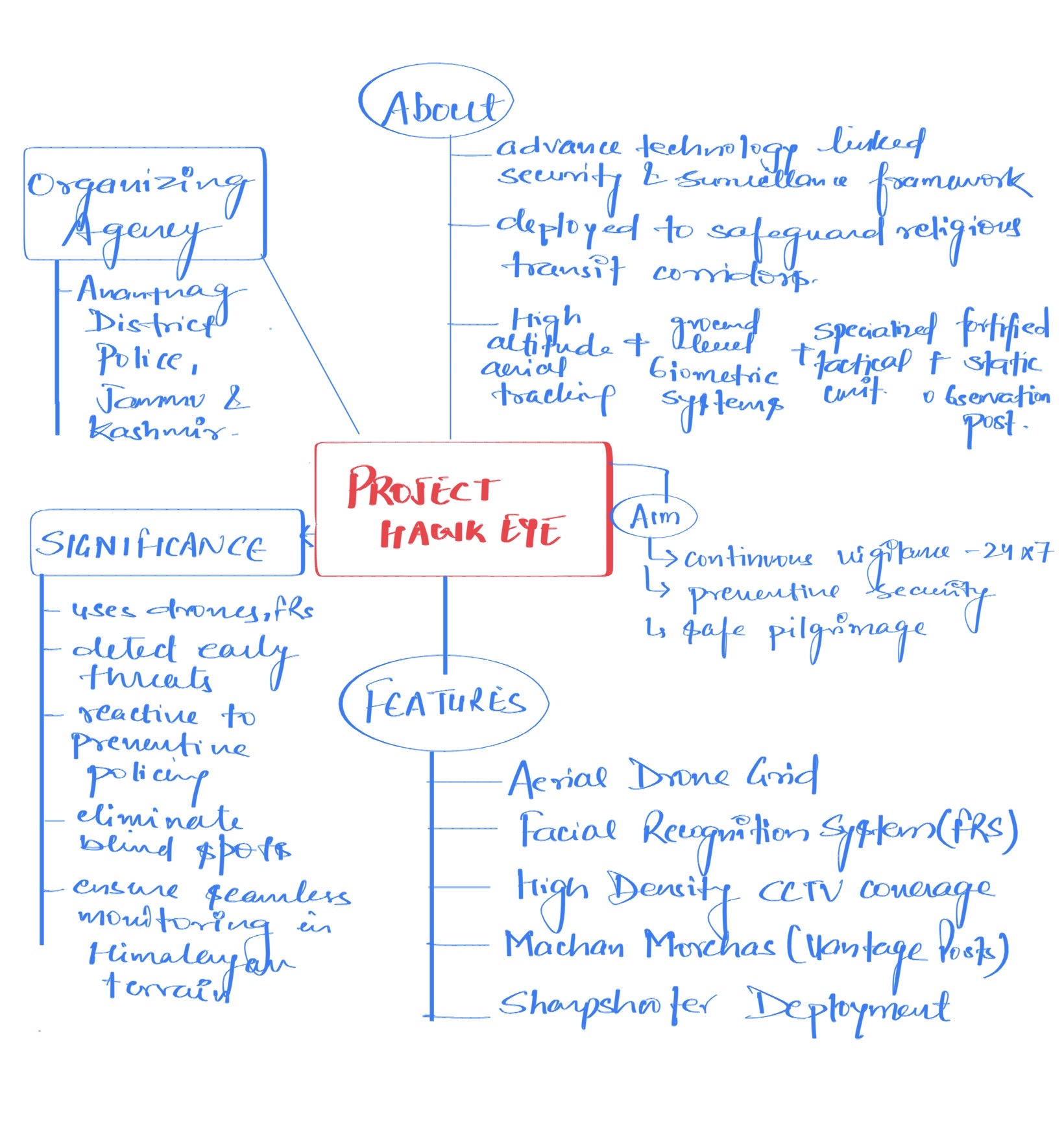
The Jammu & Kashmir Police has launched Project Hawk Eye, a technology-driven surveillance and security initiative, to strengthen security arrangements for the Shri Amarnath Ji Yatra 2026. The project aims to provide seamless, round-the-clock monitoring of the pilgrimage route by integrating aerial surveillance, artificial intelligence (AI), facial recognition systems, CCTV networks, and strategic deployment of security personnel. The initiative reflects India’s increasing reliance on technology-enabled policing to safeguard large public gatherings and critical infrastructure.
What is Project Hawk Eye?
Project Hawk Eye is a comprehensive surveillance framework developed by the Anantnag District Police to ensure the safe and peaceful conduct of the annual Amarnath Yatra. The system creates a multi-layered security architecture that combines modern surveillance technologies with conventional policing.
The project seeks to maintain continuous vigilance across vulnerable stretches of the pilgrimage route, enabling security agencies to detect threats early and respond swiftly to emergencies. By integrating real-time aerial monitoring with ground-based observation systems, the initiative aims to improve situational awareness and operational coordination.
Key Features
The project employs multiple technological and operational components:
- Drone Surveillance: Five drones have been deployed at strategic locations to provide real-time aerial monitoring of the Yatra route.
- Extensive CCTV Network: Around 416 CCTV cameras, equipped with AI-enabled facial recognition technology, have been installed to monitor movement and identify suspicious activities.
- Machan Morchas (Observation Posts): Twenty-eight elevated observation posts have been established at vulnerable locations to enhance surveillance and area domination.
- Specialized Sniper Teams: Twenty-two sniper teams have been positioned at sensitive locations to strengthen tactical preparedness.
- Integrated Command and Control: Information from drones, CCTV cameras, and ground personnel is centrally monitored to enable faster decision-making and coordinated response.
Together, these measures establish a 24×7 surveillance grid that significantly enhances the security of the pilgrimage.
Significance
Project Hawk Eye highlights the growing role of technology in internal security management.
First, it demonstrates the adoption of smart policing, where AI, drones, and digital surveillance complement conventional law enforcement. Such systems improve response time, facilitate evidence collection, and strengthen preventive policing.
Second, the initiative enhances pilgrim safety. The Amarnath Yatra attracts lakhs of devotees annually and passes through mountainous terrain vulnerable to security threats, natural disasters, and logistical challenges. Continuous monitoring can assist in crowd management, emergency evacuation, and rapid deployment of rescue teams.
Third, the project contributes to the protection of critical public events and infrastructure, an increasingly important aspect of India’s internal security strategy.
Finally, it reflects India’s broader emphasis on technology-led governance, where emerging technologies are leveraged to improve public service delivery and citizen safety.
Challenges and Concerns
Despite its advantages, Project Hawk Eye raises important governance and ethical issues.
The deployment of facial recognition systems has generated concerns regarding privacy, data protection, and the possibility of mass surveillance. India currently lacks a dedicated legal framework governing facial recognition technology, making transparency and accountability essential.
AI systems may also produce false positives or identification errors, potentially leading to wrongful suspicion or inconvenience to innocent individuals. Therefore, technological outputs should supplement—not replace—human decision-making.
The effectiveness of such projects also depends on reliable communication infrastructure, cybersecurity, trained personnel, and regular maintenance of surveillance equipment, particularly in difficult mountainous terrain.
Way Forward
Project Hawk Eye represents an important step in India’s transition towards technology-driven policing. However, its long-term success will depend on striking a balance between security and individual rights.
Future initiatives should be supported by:
- Robust data protection and privacy safeguards.
- Transparent operating procedures for AI-based surveillance.
- Regular audits of surveillance technologies.
- Capacity building of police personnel in emerging technologies.
- Integration of surveillance systems with disaster management and emergency response mechanisms.
By combining advanced technology with accountable governance, India can enhance public safety while upholding democratic values.
Conclusion
Project Hawk Eye marks a significant advancement in India’s internal security architecture by integrating drones, AI-enabled surveillance, facial recognition, and coordinated policing into a unified security framework for the Amarnath Yatra. Beyond ensuring the safety of pilgrims, the initiative exemplifies the evolving role of digital technologies in public administration and security management. For UPSC aspirants, it serves as an important example of the intersection of internal security, governance, emerging technologies, and ethical challenges in contemporary India.
UPSC Relevance
Project Hawk Eye is relevant for multiple segments of the UPSC syllabus:
GS Paper III (Internal Security)
- Role of technology in strengthening internal security.
- Use of drones, AI, facial recognition, and surveillance systems.
- Security management of religious gatherings and critical infrastructure.
- Disaster preparedness and emergency response.
GS Paper II (Governance)
- E-governance and technology-enabled public administration.
- Police reforms and modernization.
- Citizen-centric service delivery.
Essay and Ethics
- Technology versus privacy.
- Responsible use of Artificial Intelligence in governance.
- Balancing national security with civil liberties.